59 39 38 main concepts for urban legibility terms terms
Partial English project glossary
Air-entrained concrete
Air entrained concrete contains microscopic air bubbles that help alleviate internal pressure on the concrete by providing small pockets for water to expand into when exposed to freeze-thaw conditions. Without these pockets water has no place to escape, leading to cracks and/or scaling in concrete that greatly diminishes the lifespan of a structure. Air is applied into a concrete mix via an air entraining admixture otherwise known as AEA. The amount of air in a mix can be adjusted to meet the specifications of the job at hand.
Example: The primary use of air-entraining concrete is for freeze-thaw resistance.
en: Concreto con aire incorporado
Architectural concrete
Architectural concrete is concrete that will be permanently exposed to view and therefore requires special care in selection of the concrete materials, forming, placing, and finishing obtaining the desired architectural appearance.
Example: Architectural concrete has developed into one of the most important means of design in modern architecture
en: Concreto arquitectónico
Asphaltic concrete
Is a composite material commonly used to surface roads, parking lots, airports, and the core of embankment dams.
Example: The streets of my city are made of asphalt concrete
en: Concreto asfáltico
Axis
It is a straight line that joins two points in space and along which shapes and spaces can be placed.
Example: The main street is the axis of my neighborhood
en: Eje
Backup wall
Division of a geographic space by means of a material construction, exerting some kind of control over the things of people that cross that division.
Example: The slab is supported by a backup wall.
en: Muro de respaldo
Brick courses
Is a layer of the same unit running horizontally in a wall. It can also be defined as a continuous row of any masonry unit such as bricks, concrete masonry units (CMU), stone, shingles, tiles, etc.
Example: A construction has brick courses in the walls.
en: Hilada de ladrillos
Cellular concrete
Cellular concrete is a special engineered concrete manufactured by mixing Portland cement, sand, fly ash, water and pre-formed foam in varied proportions to form a hardened material having an oven-dry density of 50 pounds per cubic foot (PCF) or less.
Example: Cellular concrete consists of cement, water, aggregate and air voids.
en: Hormigón/concreto celular
Colored concrete
Colored concrete, also known as decorative concrete, allows traditional grey concrete to be stained and dyed different colors.
Concrete has been colored as far back as the early 1900s and was primarily used by companies who made precast structures for building facades. Today, it can be used to create unique designs, break up large paved areas, or hide potential stains.
It’s the fastest growing to market in the concrete business and requires highly skilled technicians who are trained in the application process to manufacture it.
Example: The sidewalk has colored concrete blocks
en: Concreto con color/coloreado
Concrete block
A concrete block is primarily used as a building material in the construction of walls. It is sometimes called a concrete masonry unit (CMU). A concrete block is one of several precast concrete products used in construction.
Example: Concrete block is one of the strongest materials.
en: Bloque de concreto
Cured concrete
Curing of concrete is defined as providing adequate moisture, temperature, and time to allow the concrete to achieve the desired properties for its intended use.
Example: Cured concrete is important to get strength development and durability of concrete.
en: Concreto curado
Dovetail insert
They are perforations used in a construction system
Example: Dovetail grooving inserts are used to machine O-ring dovetail grooves with 66° undercut angles.
en: Inserto de cola de milano
Edge
Urban borders are insurmountable limits, whether natural or artificial, that limit the day-to-day life of those who live next to them.
Example: The most notorious edge in the city of Manzanillo is the sea
en: Borde
Exposed concrete
Exposed concrete refers to concrete whose surface is a visible part of the architectural and interior design of the building. Strictly speaking, this refers to concrete surfaces that were in contact with the form work shell when they were produced.
Example: That wall has an exposed concrete finish
en: Concreto expuesto
Gravity load
Gravity loads are the vertical forces that act on a structure. The weight of the structure, human occupancy and snow are all types of loads that needs to have a complete load path to the ground.
Example: Gravity loads are independent of the type of lateral loading and here they are considered part of the structural model.
en: Carga por gravedad
Green concrete
Green concrete is defined as a concrete which uses waste material as at least one of its components, or its production process does not lead to environmental destruction, or it has high performance and life cycle sustainability
Example: green concrete will be the future of construction
en: Concreto verde
Hanging off (of)
Word used as a constructive term
Example: The bridge is hanging off from the metal structures.
en: Colgado de
Horizontal mortar joints
In masonry, horizontal mortar joints are the spaces between bricks, concrete blocks, or glass blocks, that are filled with mortar or grout. If the surface of the masonry remains plastered, the joints contribute significantly to the appearance of the masonry.
Example: Masonry ties fit in the horizontal mortar joints
en: Juntas de mortero horizontales
Insulating concrete
Insulating concrete form or insulated concrete form (ICF) is a system of form work for reinforced concrete usually made with a rigid thermal insulation that stays in place as a permanent interior and exterior substrate for walls, floors, and roofs.
Example: This insulated concrete form is cut away to show the inner structure of the formwork and the reinforcing bar.
en: Concreto aislado
Journey
It is possible to conceive of circulation as the perceptive thread that links the spaces of a building, or that brings together any set of interior or exterior spaces.
Example: Follow a journey to get to a place
en: Trayecto
Knots
They are meeting points such as street intersections, squares, or roundabouts
Example: My colony knot is the main entrance
en: Nodos
Ladder type systems
It is a construction system used in masonry
Example: If the backup wall is concrete block, there are ladder-type systems that fit in the concrete block mortar joints.
Laterally
From side to side, along a plane.
Example: Bricks are placed laterally
en: Lateralmente
Masonry ties
Artifact used in construction to support a brick wall.
Example: To prevent the brick veneer from falling off the building, we use masonry ties.
en: Amarres de mampostería
Metal channel
en: Canal metálico
Metal decking
en: Cubierta de metal
Metal framing
en: Estructura metálica
Metal grating
en: Rejilla metálica
Metal panel
en: Panel metálico
Metal rod
en: Barra de metal
Metal roofing
en: Cubierta de metal
Metal stud
en: Espárrago de metal
Metal tubing
en: Tubo de metal
Milestones
They are reference points that are recognized by everyone in a site, they are elements that are seen and unlike nodes, they are not penetrated
Example: Rey de Coliman is a recognized milestone in the city of Colima
en: Hitos
Multi-storey
A multi-storey building is a building that has multiple storeys, and typically contains vertical circulation in the form of ramps, stairs and lifts
Example: New York buildings are multi-storey
en: De varios pisos
Neighborhood
A neighborhood is one of the parts of a town where people live.
Example: All the houses in my neighborhood are white.
en: Colonia
Path
They are conduits that the observer follows normally, occasionally or potentially.
Example: The main street is the path of the neighborhood.
en: Senda
Porous concrete
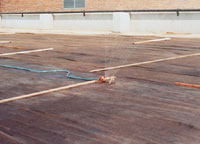
Pervious concrete (also called porous concrete, permeable concrete, no fines concrete and porous pavement) is a special type of concrete with a high porosity used for concrete flatwork applications that allows water from precipitation and other sources to pass directly through, thereby reducing the runoff from a site and allowing groundwater recharge.
Example: The streets are made of porous concrete.
en: Concreto permeable
Precast concrete
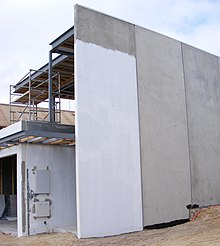
Precast concrete is a construction product produced by casting concrete in a reusable mold or "form" which is then cured in a controlled environment, transported to the construction site and lifted into place ("tilt up"). In contrast, cast-in-place concrete is poured into site-specific forms and cured on site.
Example: The wall is made of precast concrete.
en: Concreto prefabricado
Prestressed concrete
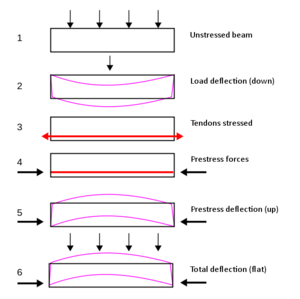
Prestressed concrete is a form of concrete used in construction. It is substantially "prestressed" (compressed) during production, in a manner that strengthens it against tensile forces which will exist when in service.
Example: Prestressed concrete is used in a wide range of building and civil structures.
en: Concreto pretensado
Reinforced concrete
It consists of the combination of two materials, concrete and reinforcing steel. These materials are combined in order to form structural elements such as beams, columns, walls, foundations, slabs, among others.
en: Concreto armado
Relief angle
The angles are attached to the concrete frame of the building to support the masonry at that floor level; however, just as importantly, the angle provides a break in the veneer to allow for the expansion and contraction of the masonry and the concrete structure.
Example: The relief angle (shelf angle) supports the weight of the brick veneer at each floor.
en: Ángulo de relieve
Steel angle
en: Ángulo de acero
Steel beam
en: Viga de acero
Steel column
en: Columna de acero
Steel framing
en: Estructura de acero
Steel joist
en: Vigueta de acero
Steel member
en: Pieza de acero
Steel plate
en: Placa de acero
Steel reinforcement
en: Refuerzo de acero
Steel reinforcing
en: Acero corrugado
Steel rod
en: Barra de acero
Steel sections
en: Secciones de acero
Supports
A structural support is a part of a building or structure that provides the necessary stiffness and strength in order to resist the internal forces (vertical forces of gravity and lateral forces due to wind and earthquakes) and guide them safely to the ground.
Example: A building needs supports to stand firm.
en: Soportes
Tie something back to
Action on construction elements
Example: The stirrups are tied to the rods of the fortress.
en: Atar algo a
Transfers
It is the action of a construction that is mainly transmitted by the columns or the structure.
Example: The column transfers the load to the ground
en: Transferencias (de cargas)
Unreinforced concrete
Construction term that refers to the lack of concrete reinforcement.
Example: The floor of the septic box is typically made of unreinforced concrete thick enough to withstand uplift pressure when the tank is empty.
en: Concreto no reforzado
Urban legibility
Urban legibility is a consequence of the characteristics of the functional and perceptual physical-spatial structure of each locality.
en: Legibilidad urbana
Urban plot
Organization composed of forms and spaces whose position in space and their interrelationships are regulated by a type of plot or by a three-dimensional field.
Example: The colony has an irregular plot
en: Trama
Wedge anchor
Wedge anchors are a unique type of concrete anchors, designed to anchor objects into concrete applications. Concrete Wedge Anchors are installed into a pre-drilled hole using the appropriate Concrete Drill Bit, where the wedge is expanded by tightening the nut.
Example: The UCAN Hook Wedge Anchor is a high grade steel fastener, designed primarily for wire mesh installation.